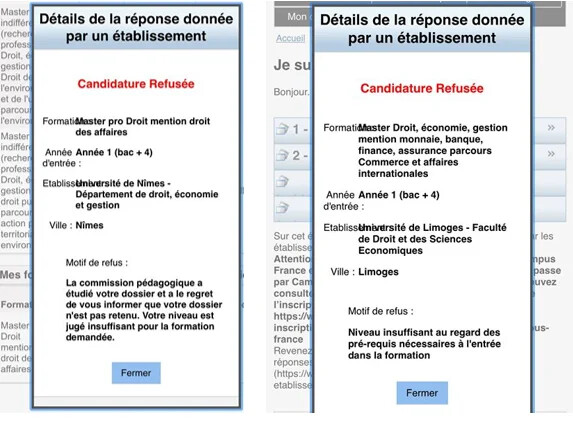
Tu viens de recevoir un refus d’admission via Campus France et tu te demandes ce qui a cloché ? Tu n’es pas seul. Chaque année, des milliers d’étudiants voient leur rêve d’étudier en France mis en pause par une décision apparemment injustifiée.
Pas de panique. Dans cet article, on te décrypte les vrais motifs de refus Campus France, ceux qui se cachent derrière les réponses types, et surtout comment les éviter pour maximiser tes chances d’acceptation en 2025 !
A lire aussi: Étudier en France, Comment obtenir son admission ?
En outre, nous tenons à te rappeler que si tu choisis l’option « Passe-Privé ESA », notre équipe d’experts t’accompagnera tout au long du processus d’obtention de ton admission et de ton visa étudiant pour la France. Ne laisse pas passer cette opportunité unique de réaliser ton rêve d’étudier en France. Prends l’initiative dès maintenant !
1.  Niveau académique insuffisant : quand les notes ne suivent pas
 Ce que ça signifie :
Les universités françaises évaluent ton parcours académique global : résultats scolaires, diplômes, classement, mais aussi progression dans tes études.
Tu peux être refusé si :
- ta moyenne est trop basse (souvent en dessous de 12/20 pour une licence, 13 ou plus pour un master),
- tes résultats sont inégaux ou en baisse,
- tu redoubles ou changes trop souvent de filière.
 Comment améliorer ton dossier :
- Mets en avant tes meilleures matières (liées à la formation visée).
- Si tu as eu un passage à vide, explique-le dans ta lettre de motivation.
- Obtiens une attestation de niveau ou lettres de recommandation pour compenser certaines faiblesses.
A lire aussi : Les 10 commandements d’une bonne lettre de motivation
2.  Redondance de la formation : tu demandes un diplôme trop similaire à ce que tu as déjà fait
Ce que ça signifie :
C’est l’un des motifs de refus Campus France les plus sous-estimés. Les universités veulent comprendre en quoi la formation demandée t’apporte quelque chose de nouveau.
Tu seras refusé si :
- tu as déjà un diplôme équivalent (ex : une licence d’économie et tu redemandes une L1 économie),
- ton projet semble répéter sans valeur ajoutée ton parcours passé.
Que faire ?
- Choisis une formation complémentaire, ou une spécialisation.
- Reformule ton projet dans la lettre de motivation : explique ce que tu cherches à approfondir ou réorienter.
- Utilise des phrases comme : « Pour renforcer ma spécialisation en… » ou « Cette formation représente un tournant stratégique car… »
3.  Capacité d’accueil atteinte : tu as postulé trop tard… ou trop demandé
Ce que ça signifie :
Les formations sont très demandées et ont un nombre de places limité. Même avec un bon dossier, si tu postules tard ou uniquement sur les filières très populaires, tu peux être refusé.
Astuces pour éviter ce piège :
- Dépose ton dossier dès l’ouverture de la plateforme Études en France.
- Diversifie tes choix : ajoute des universités moins connues ou en province.
- Ne mets pas toutes tes options sur Paris et Lyon uniquement !
4.  Projet d’étude flou ou mal justifié : les recruteurs ne te comprennent pas
Ce que ça signifie :
Ton projet professionnel est incompréhensible, incohérent ou trop vague. Les jurys veulent savoir où tu vas, pourquoi cette formation, et comment cela s’inscrit dans ton avenir.
 Que faire concrètement ?
- Structure ta lettre : parcours → pourquoi cette formation → ton objectif pro.
- Utilise des mots précis : “intégrer une entreprise dans le secteur X”, “préparer un doctorat sur Y”, etc.
- Évite les phrases clichés (“j’ai toujours aimé la France”) sans lien avec la formation.
5.  Raisons politiques ou sanitaires (exceptionnelles mais réelles)
De quoi parle-t-on ?
Dans certains cas, les refus viennent de décisions hors de ton contrôle : tensions diplomatiques, mesures sanitaires, quotas limités pour certains pays.
Que faire ?
- Renseigne-toi via Campus France et les groupes d’étudiants sur ton pays.
- Envisage un plan B : autres pays francophones, ou une formation en ligne avant une mobilité réelle.
 Acceptation Campus France : nos conseils pour 2025
- Commence tôt.
- Cible intelligemment les formations.
- Personnalise chaque lettre de motivation.
- Prépare-toi pour l’entretien Campus France.
- Et surtout : sois cohérent et motivé dans ton projet.
A lire aussi : Étudier en France : Comprendre les 7 motifs d’un refus de visa étudiant!
 Bonus : Tu veux maximiser tes chances ?
Garde à l’esprit que le « Passe-Privé ESA » peut se révéler être ta clé du succès pour tes études en France ! Fais confiance à notre équipe d’experts !